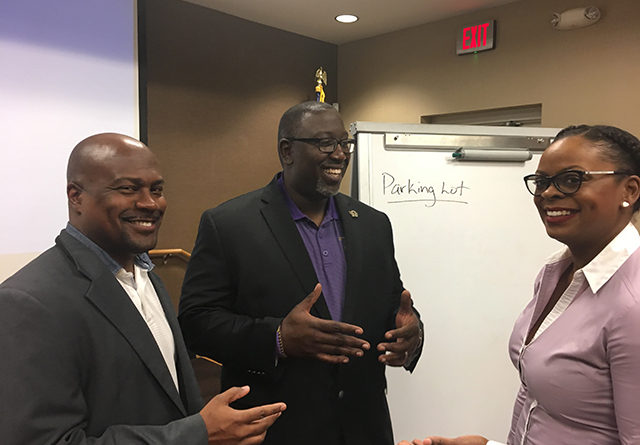
Experts advise on creating a financial legacy
With a series of direct questions those attending the recent presentation Building Your Economic Legacy at the Scott Candler Library were invited to examine their personal finances and consider how they can put themselves on the road to financial freedom. Questions included: Is your money being spent on what matters to you? Have you ever regretted a major purchase? What would your life look like without debt? If you die today, will those who are dependent on you be OK? Are your spending habits setting a good example for your children?
Ahli Moore, CEO of X-Factor Solutions who posed the questions to the south DeKalb audience, observed, “In our community, a person is more likely when they die to leave debt than to leave an inheritance for his family. It’s time to break that pattern.” Moore was one of three presenters at the session, which was the first in a series designed to help community members improve their personal financial situations.
Moore said his interest in finding a path to financial freedom and directing others to such a path came from his personal journey.
“My mother worked hard. She worked two jobs, yet we were always short of money. In my early 30s I saw myself repeating the same cycle. I had a good job, but there was never enough money to go around. About 15 years ago, I got real with myself and started to get reliable advice on financial management,” he said.
Financial goals should be organized in terms of short-term, medium-term and long-term, Moore recommended. Common short-term goals—those that can be completed in one to three years—include paying down debt, establishing an emergency fund, taking a vacation or making a major purchase. Medium-term goals—those to be completed in three to five years—might include saving for the down payment on a home, paying for additional education or creating an investment portfolio. Items to be addressed in long-terms goals—those to be accomplished in five to 10 years—might include educating children or grandchildren, starting a business, acquiring rental property and retirement.
Another presenter, Shardea M. Ages of Greenwood Wealth Management, said she, too, came from a neighborhood where people typically lived paycheck to paycheck and often cashed those paychecks at the liquor store rather than at a bank. “No matter how you grew up, you can learn to handle your money properly. You can break the generational curse of bad financial habits,” she said.
Ages, a certified financial planner, recommended as first steps that people stop living beyond their means, pay attention to where their money is going and avoid financial predators.
“Payday loans, rent to own, check cashing services, tax refund loans, ‘buy here, pay here’ car lots and credit repair services are all designed to take your money. They will not solve your problems; they will create problems for you. If you owe the IRS, you will have to pay the IRS. Anyone who tells you they can make that debt go away is just out to take your money,” she said.
“Everyone’s situation is different and specific financial advice will not apply to every situation. Make sure that anyone you hire to help you with your finances is a credentialed professional. Anyone can call himself a financial planner, but a certified financial planner must have the expertise to advise you and must put your best interest ahead of the money he or she might make selling you specific financial products,” Ages continued.
Douglas Shaw, a certified public accountant and the third presenter, said a good many people had a big surprise when they filed their 2018 tax return. “With the passage of the Tax Cuts & Jobs Act significant changes were made to the federal tax code.
Many people got slightly larger paychecks throughout the year because less was taken out for federal taxes, but if they weren’t paying enough all year, they ended up owing money on tax day.”
Shaw added, “Your goal should be to come out even—or at least within $500 of what you owe one way or the other. If you owe a large amount at tax time, that means you can end up paying even more in interest and penalties. If you get a large refund, that means you gave the government a tax-free loan.”
Paying the right amount in taxes is tax avoidance, not tax evasion, Shaw said. He recommended gathering tax-related documents in a single folder, then examining the results from prior years, looking at what went right—anticipated results—and what went wrong—surprises.
“You often hear people say, ‘pay yourself first.’ It’s good to save something from each paycheck, but when you have debts and obligations you have to pay those first or your credit will suffer, and you are likely to end up paying a lot of interest unnecessarily,” Shaw said.